To my fellow advocates, neighbors, and leaders,
My name is Holly Martinez, and I am currently recovering from major surgery. I am non-verbal, I use a wheelchair/walker, and I am an Arizona constituent. But more than that, I am a survivor of a system that is currently failing its most vulnerable citizens.
This month, I am traveling to Washington D.C. for the Disability Policy Seminar and Hill Day. I am not just going to share my story; I am going to demand a seat at the table for the rare disease and physically disabled communities.
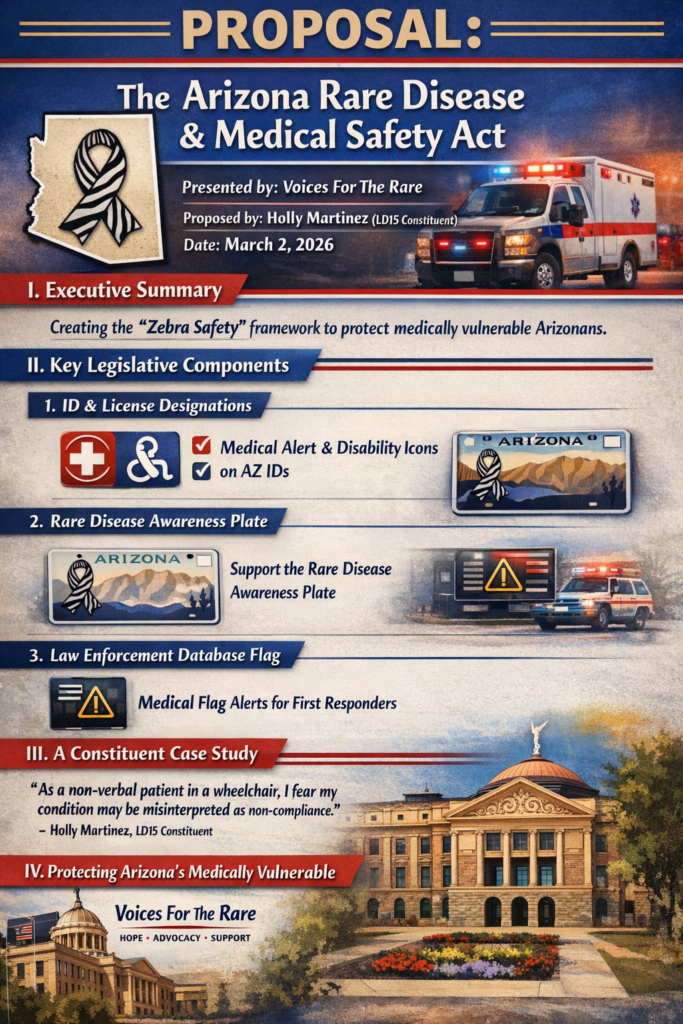
The “Zebra Safety” Act
In Arizona, we face a silent crisis. For those of us with communication barriers or rare medical conditions, a routine interaction with law enforcement or emergency services can become life-threatening in seconds. If I cannot speak to explain my medical needs, I am at risk.
The Zebra Safety Act is my proposal to bridge this gap. It creates a voluntary framework for medical identifiers on state IDs and links “Medical Flags” to vehicle databases. It is a common-sense solution designed to save lives by providing clarity during a crisis.
The Fight for Housing Equity
While I advocate for safety on our streets, I am also fighting for safety in our homes. Currently, agencies like ADOH and DDD are gatekeeping federal HUD Section 811 PRA vouchers. These funds are intended to provide permanent supportive housing for people with disabilities, yet “administrative burdens” and narrow qualifications are leaving medically fragile individuals—like myself—trapped in unsafe environments or homeless in their cars.
Our Mission in D.C.
When I meet with Senator Mark Kelly and Senator Ruben Gallego, my message will be simple: Inclusion is not an option; it is a civil right.
- We need federal oversight of how Arizona manages housing vouchers.
- We need Medicaid protected as a vital lifeline for complex care.
- We need the Zebra Safety model adopted to protect the non-verbal and medically complex.
I am re-learning to walk and talk, but I have never been more certain of my voice. I invite you to read our full legislative proposal below and join Voices For The Rare as we take this fight from Arizona to the Capitol.
In Solidarity,
Holly Martinez Founder, Voices For The Rare
.
🏛️ Policy Spotlight: The HUD 811 PRA Crisis in Arizona
The Conflict: Federal Intent vs. State Execution The HUD Section 811 Project Rental Assistance (PRA) program was created to expand housing for all extremely low-income (ELI) people with disabilities. However, Arizona’s implementation has created a “silo” system that ignores thousands of medically fragile residents.
| Feature | Federal HUD Requirement | Arizona’s Current Gatekeeping |
| Eligibility | All persons with disabilities (Physical, Rare, Developmental, etc.) | Effectively restricted to DDD or SMI behavioral health members. |
| Goal | Community Integration & Independence | Institutionalization (Nursing Homes) as the only “choice” for physical disabilities. |
| Referral Path | Direct clinical referral based on medical necessity. | “Red Tape” loop that requires a DD diagnosis even for physically paralyzed patients. |
The Legal Reality: Section 504 & The ADA Under Section 504 of the Rehabilitation Act, no program receiving federal funds can discriminate based on disability type. By limiting HUD 811 vouchers to specific “diagnoses,” Arizona is practicing Categorical Discrimination.
Our Demand: We are calling for an immediate Civil Rights Audit of the Arizona Department of Housing (ADOH). We demand that housing referrals be opened to all ALTCS members who meet ELI requirements, regardless of whether their disability is developmental or physical.
Leave a Reply